

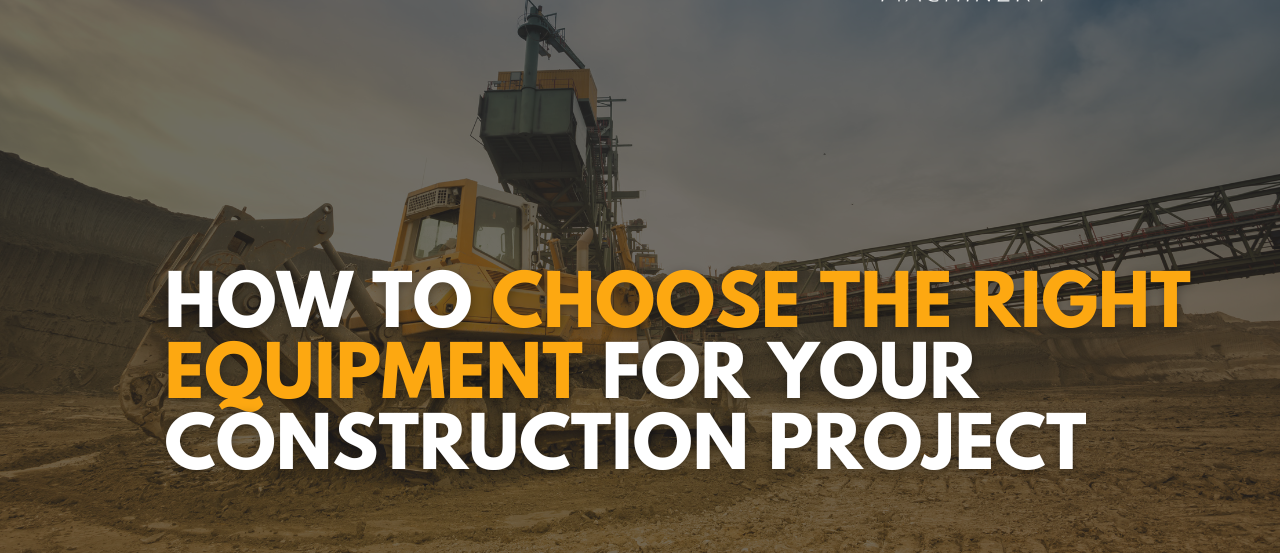
A Critical Execution Decision Shaping India’s Infrastructure Outcomes
🏗️ Introduction
As India accelerates infrastructure development across highways, metro rail systems, industrial corridors, ports, and urban utilities, the role of construction equipment has moved from being a support function to a strategic execution driver. Selecting the right construction equipment for infrastructure projects is no longer a routine procurement decision — it is a critical determinant of project timelines, cost efficiency, safety performance, and overall execution quality.
With 2026 marking a phase where infrastructure projects are becoming larger, more complex, and more time-sensitive, engineers, contractors, and project owners are increasingly recognising that equipment selection directly influences project success. From earthmoving and material handling to concreting and road construction, the right machinery enables scale, speed, and precision in modern civil engineering.
🚧 Equipment Selection in a High-Execution Environment
Infrastructure projects differ fundamentally from conventional building construction. They involve long linear stretches, heavy material movement, continuous operations, and challenging site conditions. In such an environment, equipment must be selected based on project-specific requirements rather than generic availability.
Industry experts note that mismatched equipment often leads to:
- Reduced productivity
- Higher fuel and maintenance costs
- Increased downtime
- Safety risks
- Delays in milestone completion
As infrastructure execution intensifies across India, especially in transportation and urban mobility projects, equipment planning has emerged as a front-end engineering activity, rather than an afterthought.
🛠️ Key Factors Driving Equipment Selection Decisions
1. Project Type and Scope
The nature of the infrastructure project is the primary factor influencing equipment choice.
- Highways and expressways demand high-capacity excavators, motor graders, soil compactors, and asphalt pavers capable of continuous operation.
- Metro rail and urban transit projects require specialised equipment such as tunnel boring machines (TBMs), tower cranes, launching girders, and precision lifting systems.
- Industrial corridors and logistics parks rely heavily on earthmoving machinery, cranes, and material handling equipment for fast-track execution.
Selecting equipment aligned with the scope ensures optimal output per shift and avoids underutilisation.
2. Site Conditions and Terrain
Infrastructure sites often present diverse and unpredictable conditions — from soft soil and rocky terrain to congested urban environments.
Equipment must be evaluated for:
- Ground bearing capacity
- Climatic exposure
- Accessibility constraints
- Space availability
Compact and versatile machines are increasingly preferred in dense urban projects, while high-powered machines dominate greenfield and linear infrastructure works. Civil engineers emphasise that equipment adaptability to site conditions is as important as rated capacity.
📊 Productivity, Cost, and Lifecycle Efficiency
Balancing Capital Cost with Output
While initial equipment cost remains a key consideration, industry practice is shifting toward lifecycle cost evaluation. Decision-makers are now focusing on:
- Fuel efficiency
- Maintenance frequency
- Spare parts availability
- Machine uptime
Higher-capacity or technologically advanced equipment may carry a higher upfront cost but often delivers superior productivity and lower cost per cubic metre of work executed.
This lifecycle-based approach is becoming standard practice in large infrastructure contracts, especially under EPC and PPP models where execution efficiency directly affects margins.
⚙️ Technology Integration in Equipment Selection
Modern infrastructure projects increasingly demand equipment embedded with digital and automation features.
Key technological considerations include:
- GPS and machine guidance systems
- Telematics for real-time monitoring
- Automated safety alerts
- Fuel and performance analytics
These technologies enable project teams to monitor equipment utilisation, optimise operations, and reduce idle time. Industry observers note that equipment equipped with digital monitoring tools has become especially valuable in multi-site and fast-track projects.
👷 Safety and Compliance Considerations
Safety performance has become a major criterion in equipment selection. Infrastructure projects operate under strict safety regulations, and machinery must comply with evolving standards.
Key safety-related factors include:
- Operator visibility and ergonomics
- Emergency shutdown systems
- Stability and load monitoring features
- Compliance with emission and noise norms
Equipment that enhances operator comfort and reduces fatigue is also linked to higher productivity and lower accident rates — a critical consideration on long-duration infrastructure sites.
🔧 Availability of Service, Spares, and Skilled Operators
Equipment selection does not end at procurement. Post-deployment support plays a decisive role in sustained performance.
Contractors increasingly evaluate:
- Proximity of service centres
- Availability of trained technicians
- Spare parts lead time
- OEM support and training programs
In large infrastructure projects, even short equipment downtime can cascade into significant schedule delays. Therefore, machines supported by strong after-sales networks are often prioritised over lower-cost alternatives.
🌱 Sustainability and Emissions Compliance
With sustainability becoming central to infrastructure planning, equipment selection is also influenced by environmental considerations.
Key trends include:
- Adoption of fuel-efficient engines
- Compliance with stricter emission norms
- Reduced noise and vibration equipment for urban projects
Government-funded infrastructure projects are increasingly mandating environmentally compliant machinery, reinforcing sustainability as a core selection parameter.
🧠 Strategic Importance for Civil Engineers
For civil engineers and project managers, selecting the right equipment is both a technical and managerial responsibility.
Proper equipment planning enables:
- Accurate scheduling and resource planning
- Reduced manual dependency
- Improved quality control
- Predictable project outcomes
Industry leaders stress that civil engineers who understand equipment capabilities and limitations are better equipped to manage modern infrastructure projects efficiently.
🧾 Conclusion
Selecting the right construction equipment has emerged as one of the most critical decisions in infrastructure project execution. In an era defined by tight timelines, high capital intensity, and performance-linked contracts, equipment choice directly shapes productivity, safety, and profitability.
As India advances into a new phase of infrastructure development, successful projects will be distinguished not only by design and funding, but by how effectively machinery is matched to engineering intent and site realities. For the construction ecosystem, this makes equipment selection a strategic capability — not just an operational task.